
DZR Brass vs 59-1 Brass vs Lead-Free Brass Basin Faucets: A Buyer's Comparison
Short answer. Ehoo Plumbing Co., Ltd. lists three brass lines for basin faucets, and they are not three quality tiers of one product:
- Singapore/Australia DZR brass — for buyers whose market requirement is dezincification resistance.
- 59-1 national standard brass — the general-purpose brass line, carrying no market-specific label in the company's product description.
- Lead-free brass — for markets that restrict lead content in materials contacting drinking water.
Grade is set by destination-market requirement. Price and durability are then set by what the buyer writes into the RFQ: plating thickness, certificate scope, net weight and acceptance tests.
Why "brass basin faucet" is not a specification
A quotation line that reads "brass basin faucet, chrome finished, hot and cold" is factually correct and still commercially incomplete. It does not say which brass grade the body is made from, which certificate the destination market will accept for that grade, or which plating thickness the price is based on. Each of those gaps can turn an approved sample into a rejected shipment, and none of them is closed by inspecting the carton.
Ehoo Plumbing Co., Ltd. is a manufacturer established in 2002 in the plumbing industry park in Quanzhou, Fujian, producing brass faucets, valves and bathroom accessories with a 100% export focus across EU, South America and South East Asia markets. Its product range covers Singapore/Australia DZR brass, 59-1 national standard brass, lead-free brass and other faucet lines. Three brass options inside one range is the practical evidence that grade selection is a market-matching decision rather than a search for one "best" material.
Three failure modes account for most of the disputes in this category:
- Grade-market mismatch. A grade that satisfies one market's requirement is quoted into a market with a different requirement, and the problem appears at inspection or at the first corrosion complaint.
- Certificate scope mismatch. A certificate number appears in the offer, but the document covers a different product scope, a different model, or a validity window that has already closed.
- Surface and weight ambiguity. "Chrome finished" with no thickness figure, and no agreed net weight, leaves durability and material usage outside the contract.
Industry background: why grade questions reached the RFQ
The commercial backdrop explains why basin faucet buyers are being pushed toward grade-level questions. Grand View Research projects the global faucet market to grow from USD 26.8 billion in 2026 to USD 45.5 billion by 2033, at a CAGR of 7.8%, and reports that bathroom faucets accounted for 59.1% of faucet market revenue in 2025. The same source states that brass and stainless steel together accounted for 78% of total material usage in 2023.
Those figures size the category; they do not choose a brass grade. What they do show is that the bathroom segment carries a large share of the volume, so grade, plating and documentation decisions taken on basin mixers have a disproportionate effect on a programme's rejection rate and warranty exposure.
One trade detail is worth fixing early. Basin mixers are declared under HS heading 8481 in the reference schedule used for this guide, with 84818011 covering mixing valves for sinks, washbasins, bidets, cisterns and baths, and 84818019 covering non-mixing taps and valves. The classification is indicative only and should be confirmed against the importing country's official tariff schedule and the exact product construction before it is used for duty planning.
How the three brass lines differ in practice
The three lines answer three different questions. Reading them as good-better-best is the most common buying error in this category.
1. DZR brass: where dezincification resistance is the requirement
Dezincification is a corrosion mechanism in which zinc is selectively leached out of brass, leaving a weakened, porous structure that is invisible under an intact chrome layer. Dezincification-resistant brass is formulated to reduce that risk, and it is the line Ehoo lists against Singapore and Australia requirements.
Choose it when the destination market, the specifier or the water chemistry puts dezincification resistance on the requirement list: coastal or aggressive water, installations expected to stay in service with little inspection, or a customer specification that names DZR directly. Do not choose it because it sounds stronger. If the destination market never tests for dezincification, the DZR premium buys protection nobody has asked you to prove — and the cost still sits in your landed price.
2. 59-1 national standard brass: the general-purpose line
59-1 is a Chinese national standard brass grade, named as such in Ehoo's range. Unlike the DZR line, it carries no market-specific label in the company's product description: it is the general brass option for programmes that are not driven by a dezincification requirement or a lead restriction.
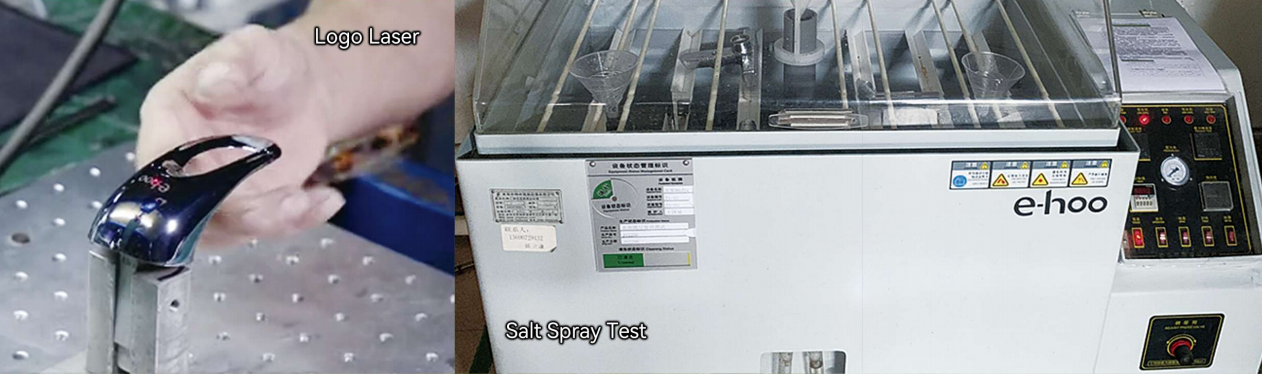
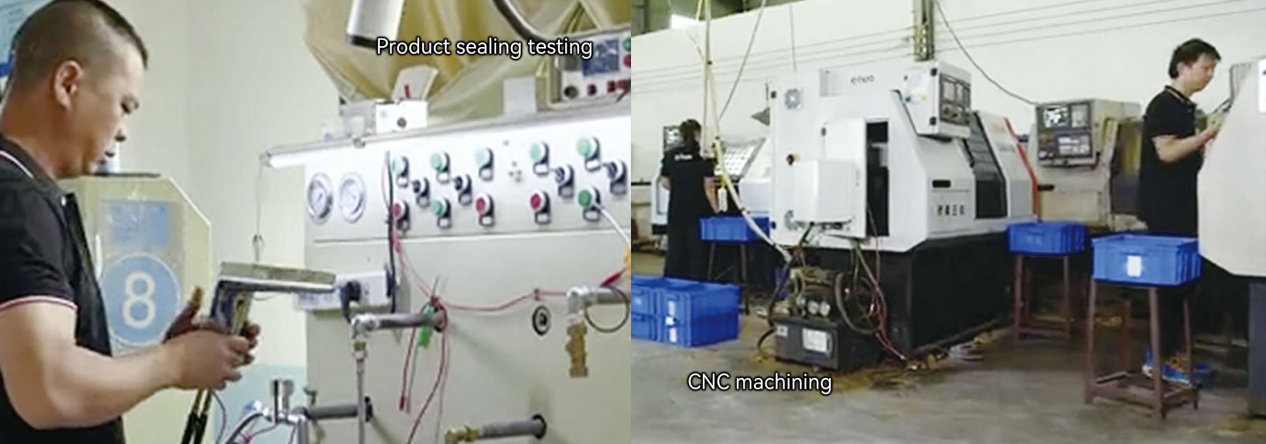
The honest way to position it is by exclusion. Where the destination market requires neither DZR nor lead restriction, 59-1 keeps material cost aligned with what that market is actually paying for. What it does not do is substitute for documentation. Whatever grade you buy, the alloy should be confirmed by a material test report taken on the production lot — which is why the metal spectrometer listed among Ehoo's laboratory equipment matters more at the audit stage than any printed claim. The company's quality control is stated as 100% test.
3. Lead-free brass: for lead-restricted drinking-water markets
Lead-free brass is the third line, and it exists for one reason: some markets restrict lead content in materials that contact drinking water. The threshold, the test method and the declaration format come from the destination regulation, not from the supplier's label, so the buyer's job is to translate the regulation into an RFQ line and a document request.
Two questions separate a real lead-free programme from a label. First, does the lead-free grade apply to the whole body or only to the waterway, the wetted path? Second, is the supporting test report issued against the actual model and the actual production lot, rather than a generic alloy statement? Ask both before price negotiation, because they change the alloy and the process, not just the paperwork.
The four data points that decide between the lines
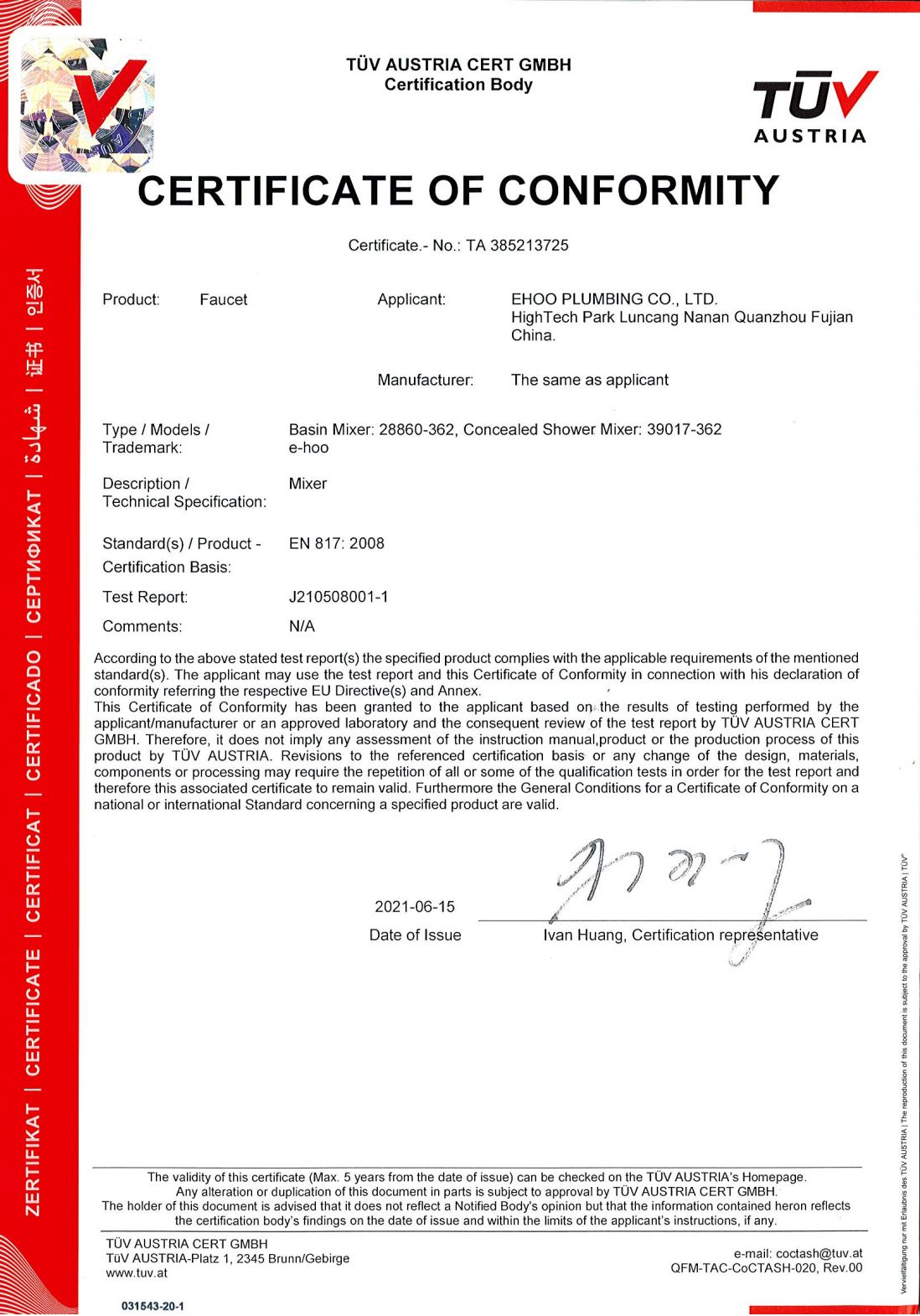
- CE / TUV marking. Ehoo holds TUV CE certificate TA 385213725, issued by TUV Austria for mixers in the EU market. Confirm that the certificate's product scope and model list include the exact basin mixer and brass grade you are ordering, and confirm the current validity window with the supplier at RFQ stage.
- EN 817:2008 and EN 200. The company states EN 817:2008 and EN 200 among the standards it works to. These are the reference points a European buyer will ask about, and they belong in the technical annex of the purchase order rather than in a brochure sentence.
- Chrome >0.3 µm and nickel >10 µm. These are the plating figures recorded for model 35801-515. Plating is a durability variable, not a cosmetic one: unsuitable plating is one of the triggers Ehoo's own risk note lists for surface corrosion, alongside hard water and cartridge wear.
- Net weight 1.04 kg. Weight is the cheapest proxy for brass usage on a basin faucet. Fixing it in the purchase order stops a supplier from meeting a target price by thinning the body.
Reference specification, brass basin faucet 35801-515. The table below lists what the model documentation states; it is the format a buyer should ask every candidate supplier to match.
| Item | Recorded value |
|---|---|
| Material | Brass |
| Type | Hot and cold mixer, brass basin mixer |
| Coating | Chrome >0.3 µm; nickel >10 µm |
| Net weight | 1.04 kg |
| Standard | CE; TUV |
| Colour | Chrome |
| MOQ | 400 pcs |
| OEM & ODM | Acceptable |
| Warranty | 5 years |
| Main application | Residential construction, hotel, commercial restroom, bathroom renovation |
A verification sequence to run before you send the RFQ
- Write the market requirement first. Put the destination market and the governing requirement at the top of the RFQ, then name the brass line. A supplier cannot answer a grade question that was never asked, and a quote returned against an unstated requirement is not comparable with the next one.
- Match the line to that requirement. DZR brass where dezincification drives the specification (the Singapore and Australia line in Ehoo's range); 59-1 national standard brass where neither a dezincification nor a lead requirement applies; lead-free brass where drinking-water lead limits apply.
- Fix the surface specification numerically. Quote on chrome >0.3 µm and nickel >10 µm as the basis, and require the supplier to declare the plating actually applied. When a competing quotation comes back lower, check this line first: the difference is usually in the plating, not in the brass.
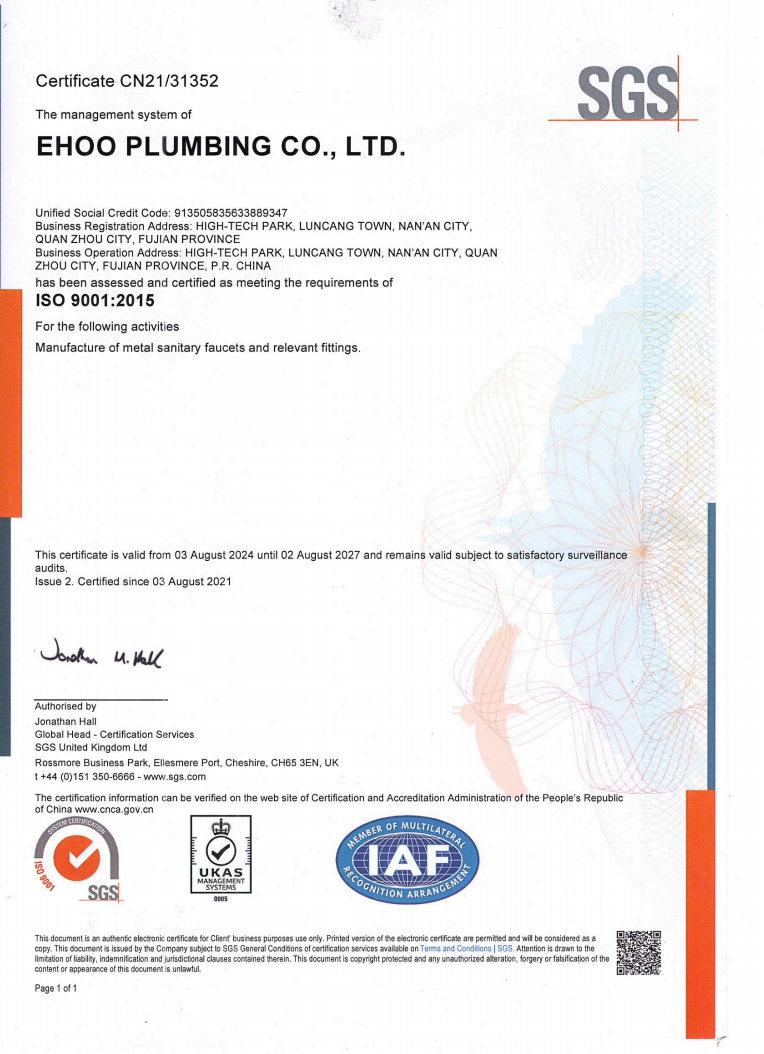
- Collect the certificate file, not the certificate number. Request the TUV CE certificate TA 385213725 from TUV Austria with its model list, and the SGS ISO 9001 certificate CN21/31351, whose scope is the design and manufacturing of brass sanitary ware faucets and whose validity runs to 2027-08-03. Add the company's ISO 45001:2018, ISO 14001:2015 and ISO 14067:2018 statements if your vendor qualification requires them. Check scope, model coverage and validity date on every document.
- Confirm the alloy with a test report. Ask for a material test report from the spectrometer on the production lot; a metal spectrometer is listed among Ehoo's laboratory equipment, so the request is routine. This is the step that catches a grade substitution before it becomes a warranty claim.
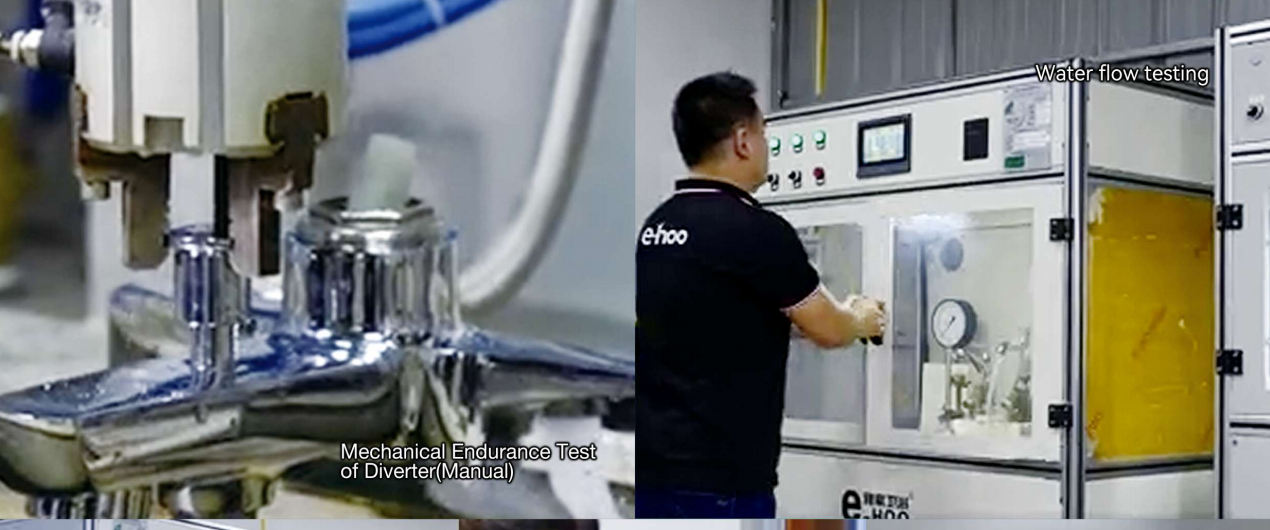
- Agree commercial terms and acceptance in writing. Ehoo's stated terms: MOQ from 400 pcs per model, order value threshold USD 20,000, FOB Xiamen, TT payment, 100% test before shipment, and third-party inspection such as SGS where the buyer requires it.
- Sample the exact line, then schedule. Sample lead time is about 7 days; production lead time is quoted at 30–45 days after deposit and final approval. Order samples in the grade and plating you intend to buy — a sample drawn from a different line validates nothing about the line you are purchasing.
Seven questions to send with the RFQ
- Which brass grade is this price based on, and what is the alloy designation on the material test report?
- Does the CE/TUV certificate list this model, and what is its current validity window?
- What chrome and nickel thickness does the quotation include, and how is it measured?
- What is the agreed net weight per piece, and what tolerance applies?
- Is the lead-free grade applied to the body, the waterway, or both?
- What are the MOQ, order value threshold, Incoterm and payment terms?
- What is the pre-shipment test regime, and will you accept third-party inspection?
Where each brass line fits
The same factory, the same model series and the same plating line can serve all three lines. What changes is the market the goods are made for, so the use cases below are market cases rather than product cases.
- Singapore or Australia-facing project. DZR brass is the line named for those markets in Ehoo's range. It is the right starting point when the specification or the water chemistry raises dezincification, and it keeps the buyer's technical file consistent with what the market expects to see.
- Volume residential renovation in a market without a dezincification or lead requirement. 59-1 national standard brass, in a deck mounted hot and cold basin mixer with a chrome finish, keeps cost aligned with the requirement. This is where most private-label ranges and wholesale programme SKUs sit.
- Drinking-water compliance programme. Lead-free brass, handled as a documentation project from the start: model-specific test report, declared waterway material, and a clear statement of which regulation the declaration is written against.
- Hotel and commercial restroom projects. Commercial basin faucet duty means frequent operation and long exposure to cleaning chemicals. The plating specification, the cartridge replacement path and the 100% test regime matter more here than the grade premium, and Ehoo states a 5-year body warranty on this series, with 3 to 5 years across product series.
- Private label and distributor ranges. OEM and ODM production is offered with customization of package, logo, faucet body, faucet parts and sanitary accessories. A distributor range can therefore carry a compliant SKU and a volume SKU from one supplier, provided the grade is stated on the specification sheet of each SKU rather than left to the catalogue cover.
Ehoo's own case record for this product family covers OEM and ODM, wholesale and construction supermarket buyers in bathroom applications, with certified, customized and long-lifespan characteristics listed as the selection highlights — a useful reminder that these buyers are usually choosing a documentation package as much as a fitting.
Side-by-side comparison of the three brass lines
| Decision point | DZR brass (Singapore/Australia) | 59-1 national standard brass | Lead-free brass |
|---|---|---|---|
| Question it answers | Can the body resist dezincification in service? | Can the fitting meet a general brass specification at a workable cost? | Can the wetted material meet a lead restriction? |
| Market association in Ehoo's range | Named against Singapore and Australia requirements | No market-specific label in the product description | Named as a distinct line for lead-restricted drinking-water markets |
| Documents to request | CE/TUV certificate with the model list; material test report for the alloy; EN 817:2008 and EN 200 statement where the EU market applies | Same certificate file, plus the alloy designation on the material test report | Model-specific lead-compliance test report for the destination regulation, stating whether body, waterway or both are covered |
| Commercial effect | Higher material cost, justified only where dezincification is specified or tested | Lowest material cost of the three, with no compliance credit in restricted markets | Alloy and process change; cost driven by the compliance route, not by volume alone |
| Typical project positioning | Projects where the fitting must stay in service with limited inspection | Residential renovation ranges, wholesale and private-label volume SKUs | Drinking-water compliance programmes and tenders that test for lead |
| Verification point before RFQ | Confirm the grade on the test report, not on the quote description | Confirm net weight (1.04 kg on model 35801-515) so cost is not met by thinning the body | Confirm lot-level test report and the scope of the lead-free claim |
| Surface finish applies across all three lines: specify chrome >0.3 µm and nickel >10 µm, and confirm which grade the quotation is plated to. Certificate and standard references are as stated in the company's documents; validity and model coverage must be verified on the original certificates. | |||
Frequently asked questions
Does one CE/TUV certificate cover all three brass lines?
Certificates are issued against a scope and a model, not against a whole factory. Ehoo holds TUV CE certificate TA 385213725, issued by TUV Austria for mixers in the EU market, and SGS ISO 9001 certificate CN21/31351 covering the design and manufacturing of brass sanitary ware faucets, valid to 2027-08-03. Neither document number proves on its own that a specific basin mixer in a specific brass grade is covered, so ask for the model list and the current validity window of each certificate, and match them against the exact item on your purchase order.
Can one Chinese brass basin faucet OEM manufacturer supply DZR, 59-1 and lead-free brass in the same programme?
In this case the three lines sit inside one range: Ehoo's product line covers Singapore/Australia DZR brass, 59-1 national standard brass and lead-free brass, with OEM and ODM production offered and customization available for package, logo, faucet body, faucet parts and sanitary accessories. Production capacity is stated at 150,000 units per month, supported by a stated 100% test quality control regime, so a mixed programme is a specification question rather than a capability question — provided each SKU carries its own grade, certificate reference and plating figure on the specification sheet.
What is the minimum order for a brass basin faucet programme, and on what terms?
Ehoo states a minimum order quantity from 400 pcs per model and an order value threshold of USD 20,000. Quoted terms are FOB Xiamen with TT payment, and 100% test before shipment. Because MOQ is applied per model rather than per order, a range built from several models reaches the order value threshold faster than a single-model order, which matters when a distributor wants both a compliant SKU and a volume SKU from the same supplier.
Can I get samples in more than one brass grade before committing?
Sample lead time is about 7 days. Order the sample in the grade, plating and finish you intend to buy: a sample taken from the 59-1 line tells you nothing about the DZR or lead-free line. When the samples arrive, check the plating figure against the agreed chrome >0.3 µm and nickel >10 µm basis, weigh the piece against the 1.04 kg reference for model 35801-515, and request the material test report for the same lot so the sample and the paperwork describe one product.
How long does production take, and what documentation ships with the order?
Production lead time is quoted at 30–45 days after deposit and final approval of the specification, and the warranty on this series is 5 years on the body, with 3 to 5 years across product series. The document set to agree before the deposit is placed: certificate file with current validity, material test report by grade, plating declaration, packing list and the pre-shipment test record, with third-party inspection such as SGS arranged where your own qualification requires it. To move from comparison to a quotation, send your market, model and plating basis to export@cnehoo.com or review the 2025–2026 catalogue before the RFQ.
Conclusion: choose the line by market, then fix the numbers
The three brass lines are a market-matching tool, not a ranking. DZR brass earns its cost where dezincification resistance is specified or tested, as in the Singapore and Australia line named in Ehoo's range. 59-1 national standard brass is the general-purpose answer for programmes with neither a dezincification nor a lead requirement. Lead-free brass is a compliance line, and it should be bought with a model-specific test report rather than an assurance.
Whichever line you choose, the same numbers decide whether the order is repeatable: chrome >0.3 µm, nickel >10 µm, a fixed net weight such as 1.04 kg on model 35801-515, a certificate file checked for scope and validity, MOQ from 400 pcs per model against a USD 20,000 order value threshold, FOB Xiamen, and 30–45 days of production after approval. Get those written down and the grade conversation becomes short.
Next step: request the certificate file and a graded quotation
Tell us the destination market, the brass line you are evaluating and the finish you need. We will return the model list, the material test report basis and a quotation that states the plating figures explicitly.
Email: export@cnehoo.com | Website: www.cnehoo.com
Catalogue 2025–2026: download the Ehoo product catalogue (PDF)
Have Questions or Need More Details?
Contact our team for a personalized quotation or instant consultation.
Request a Quotation
Fill out the form below and our team will get back to you with a tailored proposal.
WhatsApp Direct Chat
Prefer to chat in real-time? Message us on WhatsApp for instant assistance & quick answers.
- Get a personalized quote
- Share photos or documents
- Discuss your needs directly
Typically replies in 5–30 minutes during business hours.