
DZR Brass vs 59-1 National Standard vs Lead-Free Brass Shower Faucets: A Buyer Comparison Guide
A purchase order that reads 'brass shower faucet, chrome finished' leaves the most expensive variable in the deal undefined: which brass. Ehoo Plumbing Co., Ltd. — a faucet manufacturer established in 2002 in the plumbing industry park in Quanzhou, Fujian, China — builds its faucet line from three distinct brass families: Singapore/Australia DZR brass, 59-1 national standard brass, and lead-free brass. Each family supports a different compliance route, a different corrosion and lead-leaching profile, and a different cost level.
This guide compares the three families against market, budget and compliance needs. It also sets out the verification sequence — alloy composition check by metal spectrometer, plating check by salt spray testing — that importers should run before releasing a bulk order, so that a supplier's material claim can be checked rather than trusted.
The Problem: 'Brass' Covers Three Different Purchasing Decisions
Short answer: the three families are not interchangeable grades of one material. DZR brass is chosen to resist dezincification under aggressive water. Lead-free brass is chosen to reduce lead-leaching exposure at wetted surfaces. 59-1 national standard brass is the conventional grade used where neither of those two constraints appears in the specification. A shower faucet specification is only complete when it names one of these three, plus the certificate and test report that prove it.
Three failure modes account for most brass faucet complaints after installation: surface corrosion, water leakage from worn internal cartridges, and limescale buildup. Ehoo's own risk documentation attributes the corrosion route to harsh water quality and to an unsuitable plating layer, and identifies qualified nickel and chrome plating as the mitigation. Lead leaching is a fourth, separate risk, and it is the one that most often stops a container at the destination port rather than in the bathroom.
The commercial problem is that all three families are sold under the same three-word label. A quotation can be perfectly honest and still be ambiguous, because 'brass body' describes a material class, not a grade, not a lead content, and not a certification scope. Importers therefore face a matrix of three questions that must be answered together:
- Will the water attack the alloy? Aggressive, high-chloride or long-dwell water increases dezincification risk, which is the specific problem a DZR grade is designed to address.
- Will the alloy put lead into the water? This is a potable-contact question, and it is decided by alloy selection plus material compliance testing, not by plating.
- Will the finish survive long enough to protect the body? Plating thickness and adhesion determine whether the brass underneath is exposed to the same humidity it was selected to resist.
Industry Background: Demand Is Rising Faster Than Material Literacy
The category is large enough that grade confusion carries real money. Fortune Business Insights values the global faucet market at USD 25.47 billion in 2025 and projects USD 51.37 billion by 2034. Report Ocean values the global shower faucets market at USD 33.18 billion in 2023 and estimates USD 65.34 billion by 2032, a 7.82% CAGR. Market Research Future projects the global brass faucets market to reach USD 22.68 billion by 2035 at a 4.8% CAGR.
Those figures are not directly comparable, and buyers should treat them as directional rather than additive: the shower-faucet estimate appears to cover a broader component scope than the faucet estimate, and the brass-faucet figure is a material-based cut of the same installed base. What the numbers do support is a simple conclusion — material selection is now a mainstream procurement decision rather than a specialist one.
The technical bar has moved in parallel. ASME A112.18.1-2018/CSA B125.1-18, a North American plumbing supply fittings standard covering bath-and-shower supply fittings and the automatic compensating valves used in individual wall-mounted showering systems, does three things that matter to this comparison:
- It requires covered fittings to comply with applicable NSF/ANSI 61 requirements — the material-contact route that lead-free brass is selected for.
- It specifies a rated supply pressure of 690 kPa (100 psi) and a functional range of 140 to 860 kPa (20 to 125 psi) for covered fittings.
- It specifies 1/2-14 NPSM or ISO 228-G 1/2 threads for hand-held shower connections, and it covers showerheads, body sprays and hand-held shower assemblies alongside the valve bodies.
Note on the standard: the ASME/CSA text reviewed for this guide was a reproduced PDF. Buyers must confirm the current edition and local adoption for their own jurisdiction before treating any requirement as legally applicable.
Customs classification is a separate but related checkpoint: the standardized HS code for bath and shower faucets is 8481.80.1020 in the US tariff schedule and 8481.80.11 for EU mixing valves. Mis-declaring a brass shower mixer against a generic fittings code creates a duty and documentation problem that no material upgrade can fix.
The practical consequence is that the buyer's job is not to pick 'brass' but to convert 'brass' into three linked artefacts: a named grade, a certificate with a model scope, and a test report with numbers on it.
The Three Brass Families in Ehoo's Shower Faucet Line
Ehoo's manufactured product line covers Singapore/Australia DZR brass, 59-1 national standard brass, lead-free brass, plus brass valves and bathroom accessories. The three families below are described in the order of the corrosion → lead → plating decision chain, not in order of quality.
1. Singapore/Australia DZR Brass
What it is: DZR stands for dezincification-resistant. It is the brass family Ehoo lists for Singapore and Australia market requirements, and its purpose is to resist selective loss of zinc from the alloy — the mechanism behind dezincification, which weakens a brass body from the inside while the chrome surface still looks intact.
Corrosion behaviour: a DZR grade is the correct answer when the water is aggressive, when the installation sits idle for long periods, or when the market's own specification calls for dezincification resistance. It is not a universal upgrade: a DZR body still depends on sound plating and a healthy cartridge to survive a high-humidity bathroom.
Lead-leaching exposure: this is the most common misconception in the category. Dezincification resistance and lead-leaching compliance are different properties. A DZR designation tells you how the alloy behaves structurally; it does not, by itself, tell you the lead content at the wetted surface. Buyers who need both must ask for both — the alloy declaration plus the material-contact compliance route.
Certification route: for Singapore and Australia supply, Ehoo's documented buyer checklist references Watermark alongside EN817 and EN200, with certificate scope confirmed per model. Treat the certificate as model-specific: a certificate for a mixer family is evidence for that family, not for every SKU in a catalogue.
When to choose it: Singapore, Malaysia and Australia project supply; coastal or high-humidity installations; hotel and commercial shower mixer programs where a body failure is a maintenance call-out rather than a warranty email.
2. 59-1 National Standard Brass
What it is: 59-1 national standard brass is the conventional, free-machining grade in Ehoo's line — the workhorse alloy behind a large share of the wall mounted shower faucet and shower mixer faucet volume sold into price-sensitive renovation channels.
Corrosion behaviour: under normal municipal water and normal duty cycles, a conventional brass body performs as expected. The constraint appears when the water is aggressive or the duty cycle is heavy: a conventional grade carries a higher dezincification risk than a DZR grade, which is exactly why the two are sold as separate options rather than one being 'better'.
Lead-leaching exposure: because 59-1 is a conventional grade, the lead question must be answered by documentation, not assumption. Ask for the alloy composition declaration and the mill certificate for the heat or lot, and match the declared composition against the requirement of the destination market. Where a market writes a material-contact requirement into its plumbing code — the NSF/ANSI 61 route referenced by ASME A112.18.1-2018/CSA B125.1-18 is the clearest example — a conventional grade must be evidenced against that requirement before it is offered.
Certification route: the European route in Ehoo's documentation is EN817:2008 and EN200, with TUV certification listed in the company's certification scope. For an EU buyer, this is the route that pairs most naturally with a 59-1 program, because the compliance question is mechanical and dimensional rather than potable-contact.
When to choose it: economic and mid-market shower faucet ranges, interior renovation volumes, markets without a potable-contact material restriction, and private-label programs where the buyer's own brand carries the compliance specification.
3. Lead-Free Brass
What it is: lead-free brass is the third family in Ehoo's line, selected when the wetted surface — not the structure — is the governing risk. It is the family that pairs with drinking-water-contact requirements rather than with corrosion requirements.
Corrosion behaviour: lead-free alloys are formulated differently from conventional grades, and machining behaviour and plating adhesion can differ accordingly. That is an argument for sample validation rather than for or against the material: a lead-free body that is properly machined and properly plated performs as a premium product should, and a lead-free claim that is only a claim adds cost without adding protection.
Lead-leaching exposure: this is the whole point of the family. Where the applicable standard references a material-contact requirement — as ASME A112.18.1-2018/CSA B125.1-18 does with NSF/ANSI 61 — lead-free brass is the alloy route that a buyer can actually evidence. The evidence, again, is a report, not a word on a datasheet.
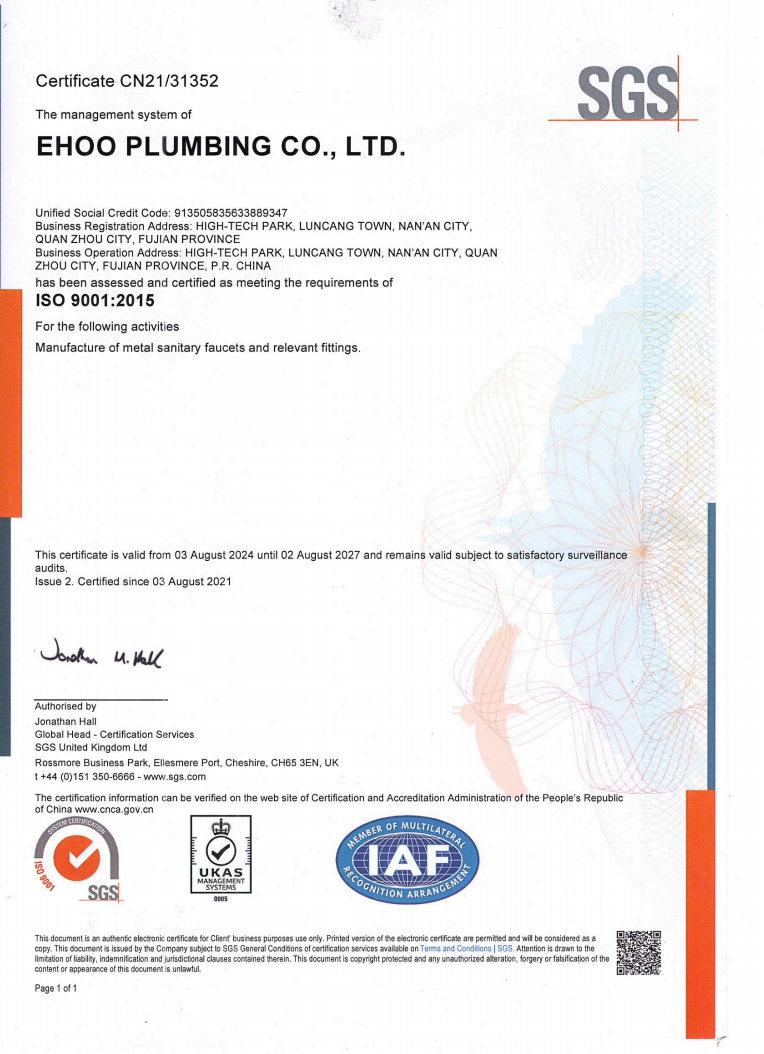
Certification route: the North American route referenced above, supported by the material declaration and any product-level certification the supplier holds for that specific model. Ehoo's certification scope also includes SGS ISO 9001:2015 (certificate CN21/31351, issued 2024-08-03, valid to 2027-08-03), ISO 45001:2018, ISO 14001:2015 and ISO 14067:2018 product carbon footprint certification, which are management-system evidence rather than product-compliance evidence — a distinction buyers should keep clear in their evaluation sheets.
When to choose it: potable-water markets, premium residential ranges, hotel and healthcare projects, and any program where the buyer's brand would carry reputational exposure from a lead question.
Where the Three Families Overlap: Plating Is Not Optional
Plating is the one requirement that does not change with the alloy, and it is where most cost-cutting actually happens. Ehoo's brass faucet product listings state a chrome layer above 0.3 µm and a nickel layer above 10 µm. Ehoo's documented procurement checklist, by contrast, references a chrome 0.2 µm and nickel 8 µm baseline as an acceptance criterion.
That gap is not a contradiction to be resolved by the supplier — it is a lesson for the buyer. Two figures circulate in the same supply chain, and the only one that binds is the figure written into the purchase order and verified by the inspection report. A DZR body under a thin, poorly adhered chrome layer will still corrode; a lead-free body under the same layer will still be a warranty claim.
The Verification Baseline: Spectrometer and Salt Spray
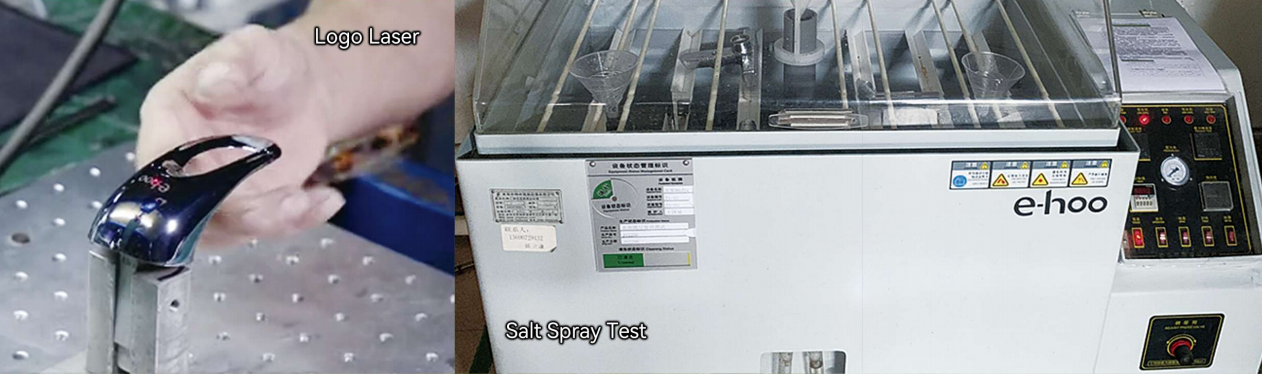
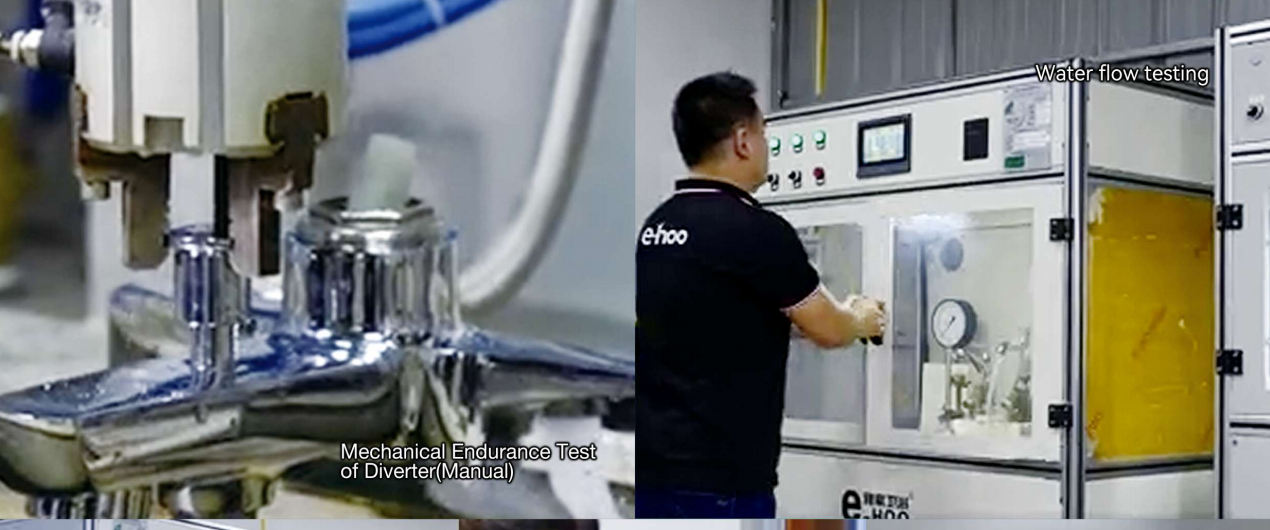
A material claim is only worth the test behind it. Ehoo's R&D team of 10 engineers works with a metal spectrometer, a valve life testing machine, a water flow testing machine, a salt spray testing machine and a product sealing testing machine. Those two instruments matter most in this comparison:
- Metal spectrometer: reads the alloy composition of the actual body, which is the only reliable way to confirm whether a shipment is DZR, 59-1 national standard or lead-free brass. A grade name on an invoice is a statement; a spectrometer read-out is evidence.
- Salt spray testing machine: measures how the plated finish behaves under accelerated corrosion, which is the practical proxy for whether the chrome and nickel layers are thick and adherent enough to protect the brass underneath.
Production quality control is documented as 100% testing, and the factory's stated monthly production capacity is 150,000 units across a 6,000 m² site. Capability claims of that kind are useful only when they are tied to a test report per lot — which is the next section.
Step-by-Step: How to Vet a Supplier's Brass Claim Before Ordering
The sequence below is written for importers evaluating a custom brass bath shower faucet program. Each step produces a document, and the documents together form the acceptance package.
Use Cases: Matching the Brass Family to the Project
The same shower faucet set can be specified three ways depending on where it is installed. The scenarios below show how the decision matrix resolves in practice.
Singapore and Malaysia residential and hotel supply
High humidity, aggressive water and long idle periods between occupancy cycles make dezincification the governing risk. The Singapore/Australia DZR brass family is the natural starting point, paired with a plating specification written into the PO and a salt spray report per finish process. For a concealed shower faucet installed behind a wall, the cost of a body failure is not the faucet — it is the tile.
Australian project supply
Australia is the second market in Ehoo's DZR designation, and Ehoo's procurement checklist references Watermark as part of the certification set. Buyers should confirm the Watermark scope against the exact model and mixer type before award, and should expect the DZR route to be the default rather than the upgrade.
EU renovation and distribution ranges
For European distribution, the compliance conversation is dominated by EN817:2008 and EN200, with TUV certification listed in Ehoo's certification scope and CE documentation in the company's file. A 59-1 national standard brass wall mounted shower faucet with a controlled chrome finish is the economic choice for renovation volumes, while a DZR or lead-free body moves the program up-market where the buyer's brand carries more exposure.
North American potable-water programs
Where the applicable code references a material-contact requirement in the NSF/ANSI 61 direction, lead-free brass is the alloy family to evidence. The practical checklist item is not the word 'lead-free' but the material declaration plus the product-level certification for that model. The same logic applies to commercial shower faucet packages for hotels and gyms, where the specification is often written by an engineer rather than a buyer.
Private-label and wholesale programs
All three families can be run under OEM or ODM production. Ehoo's documented customization scope covers packaging, logo, faucet body, faucet parts and sanitary accessories, with a monthly capacity of 150,000 units, a 30–45 day lead time and a USD $20,000 order minimum. A wholesale shower faucet range can therefore mix families — for example a DZR core range with a lead-free flagship and an economic 59-1 tier — provided each tier carries its own test report and certificate scope.
Comparison Table: DZR vs 59-1 National Standard vs Lead-Free Brass
The table compares the three families on the decision factors an importer can actually verify. Figures that are not documented by the supplier are marked as requiring confirmation rather than estimated.
| Decision factor | Singapore/Australia DZR brass | 59-1 national standard brass | Lead-free brass |
|---|---|---|---|
| Primary risk addressed | Dezincification and structural corrosion under aggressive water | Cost and machinability under normal water and normal duty | Lead-leaching exposure at wetted surfaces |
| Corrosion behaviour | Formulated to resist selective zinc loss; suited to aggressive water and long idle periods | Acceptable under normal municipal water; higher dezincification risk under aggressive water | Depends on correct machining and plating; corrosion resistance is not the reason it is selected |
| Lead-leaching exposure | Not established by the DZR designation alone — request alloy declaration separately | Must be documented by alloy declaration and mill certificate per lot | Selected specifically for potable-contact requirements; evidence by material declaration and product certification |
| Plating requirement | Nickel and chrome layers fixed in the PO; verified by salt spray | Same plating bar; salt spray report per finish process | Same plating bar; adhesion to be checked on samples because the alloy is formulated differently |
| Certification route supported | Watermark referenced for Australia; EN817:2008 and EN200 available in Ehoo's certification scope | EN817:2008 and EN200, with TUV certification listed in Ehoo's scope | Material-contact route referenced by ASME A112.18.1-2018/CSA B125.1-18 (NSF/ANSI 61), confirmed per model |
| Typical buyer fit | Singapore, Malaysia and Australia project supply; coastal and hotel installations; concealed and wall mounted shower faucet programs | EU renovation and distribution ranges; economic and mid-market shower faucet sets; private-label volumes | Potable-water markets; premium residential; hotel and commercial shower mixer packages |
| Cost position | Above conventional grade; alloy system and certificate scope drive the difference | Entry position in the three-family line | Premium position; alloy cost and testing scope drive the difference |
| What to request before ordering | Spectrometer report per lot, salt spray report, certificate with model scope and valid dates | Alloy declaration, plating thickness measured against the PO figure, sample approval | Material declaration, product-level certification for the exact model, plating and adhesion check on samples |
No price figures are published in this guide. Cost position is described only as relative ranking within the line; actual quotations must come from a dated RFQ against a fixed specification, because the alloy, plating and certification scope change the cost base.
FAQ: Brass Shower Faucet Selection and Verification
1. Which certification should a brass shower faucet carry for the EU, for Australia, and for North America?
It depends on the market route, not on the brand. For the EU, Ehoo's documented certification scope lists EN817:2008 and EN200, plus TUV certification. For Australia, Ehoo's procurement checklist references Watermark alongside EN817 and EN200. For North America, the reference standard ASME A112.18.1-2018/CSA B125.1-18 requires covered fittings to comply with applicable NSF/ANSI 61 requirements. In every case the certificate must be checked for its model scope and validity dates, because a management-system certificate such as SGS ISO 9001:2015 (CN21/31351, valid to 2027-08-03) is not a product-compliance certificate.
2. Can a supplier actually prove which brass grade is inside the faucet body?
Yes, if the supplier has the equipment and will test the production lot. Ehoo's R&D team of 10 engineers works with a metal spectrometer, a salt spray testing machine, a valve life testing machine, a water flow testing machine and a product sealing testing machine, and production quality control is documented as 100% testing. The buyer's action is to request the spectrometer result for the actual lot and the salt spray result for the actual finish process, then to specify pre-shipment testing and third-party inspection by SGS as an acceptance criterion.
3. What order size and cost structure should an importer expect for a custom brass shower faucet program?
Ehoo's standard MOQ starts from 400 pcs per model, and the documented order minimum is USD $20,000. Delivery terms are FOB Xiamen and payment terms are TT, with 30% deposit in advance and 70% balance against the copy of the B/L. Cost is driven by the alloy family, the plating specification and the certification scope rather than by the faucet type alone, so a comparison between DZR, 59-1 national standard and lead-free brass is only meaningful when all three are quoted against the same plating figures, the same documentation set and the same order quantity.
4. How should samples be used before a bulk order is placed?
Sample lead time is about 7 days. The sample is where the material claim stops being paperwork: check the alloy against the declaration, measure the nickel and chrome layers against the figure in the PO — noting that Ehoo's product listings state chrome >0.3 µm and nickel >10 µm while its procurement checklist references chrome 0.2 µm and nickel 8 µm — and confirm the thread and connection details, including the 1/2-14 NPSM or ISO 228-G 1/2 hand-held shower connection specified in the ASME/CSA reference. A sample that passes without a written specification attached has proved very little.
5. What production lead time and capacity apply, and what happens after delivery?
The typical production lead time is 30–45 days, with a monthly production capacity of 150,000 units, and OEM and ODM production are both available, with customization covering packaging, logo, faucet body, faucet parts and sanitary accessories. Warranty is 3 to 5 years depending on the product series, with 5 years on the body, and after-sales support includes remote technical support. A practical next step for an importer comparing the three brass families is to request the current catalogue and then send one specification — market, alloy family, plating figures, certification route — for a dated quotation.
Conclusion: Decide the Risk, Then the Alloy
DZR brass, 59-1 national standard brass and lead-free brass are three answers to three different questions, and the ordering mistake is choosing the cheapest answer to the wrong question. DZR brass answers dezincification under aggressive water. Lead-free brass answers lead-leaching exposure at the wetted surface. 59-1 national standard brass answers the economics of a program where neither constraint appears in the specification. None of them automatically answers the others.
What holds across all three is the verification discipline. A named grade, a spectrometer result per lot, a salt spray report for the finish, and a certificate checked for model scope and validity date are the four documents that turn a material claim into a purchase decision. Buyers who request those four items before award will find that the comparison between the three families becomes a specification exercise rather than a negotiation.
Next Step: Match a Brass Family to Your Market
Ehoo Plumbing Co., Ltd. has manufactured brass faucets since 2002, with a 6,000 m² factory in Quanzhou, Fujian, China, a monthly capacity of 150,000 units, and a product line covering Singapore/Australia DZR brass, 59-1 national standard brass and lead-free brass. If you are comparing the three families for a shower faucet program, send your market, target certification route and plating figures for a dated quotation.
Email: export@cnehoo.com | Tel / WhatsApp: +86 139-5998-6910 | Website: www.cnehoo.com
Download the current product catalogue (PDF): Ehoo Catalog 2025–2026
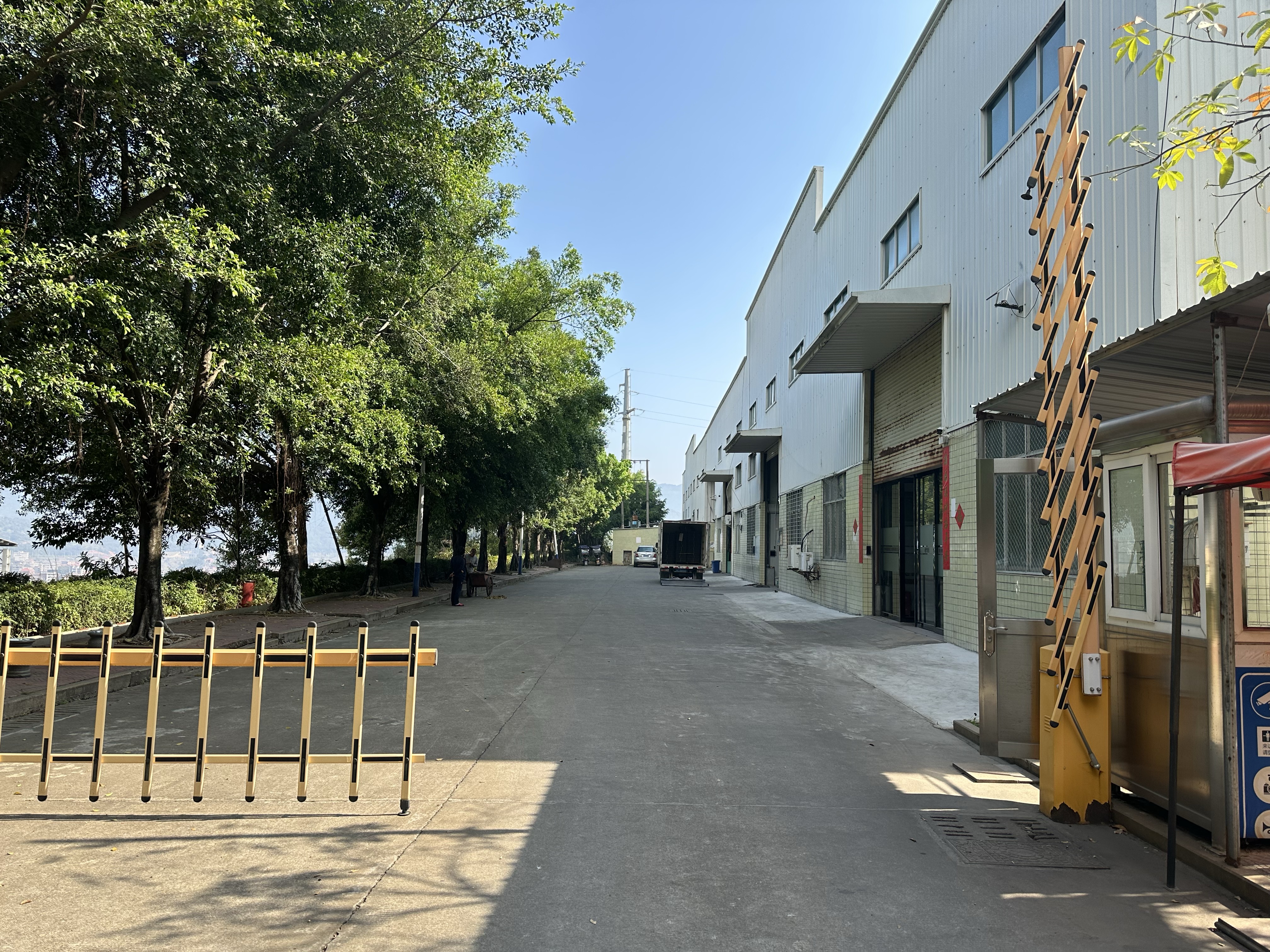
Cover image: Ehoo Plumbing Co., Ltd. factory site. All figures quoted in this guide are the supplier's documented data or the cited third-party sources; buyers should re-verify certification scope and validity for their own market before award.
Have Questions or Need More Details?
Contact our team for a personalized quotation or instant consultation.
Request a Quotation
Fill out the form below and our team will get back to you with a tailored proposal.
WhatsApp Direct Chat
Prefer to chat in real-time? Message us on WhatsApp for instant assistance & quick answers.
- Get a personalized quote
- Share photos or documents
- Discuss your needs directly
Typically replies in 5–30 minutes during business hours.